Halal food on Phuket’s west coast: Bang Tao, Surin, Kamala and Laguna — a practical guide
This stretch of coast is one of the easiest parts of Phuket to eat halal. Cherngtalay — the sub-district that covers Surin Beach and Bang Tao — has a long-established Muslim community, so Muslim-run kitchens, halal butchers and alcohol-free cafés are normal here rather than a hunt. What you will not get is a label on every door: most places are halal by ownership and habit, not by certificate, so you still ask. Pork, pork fat and Chinese cooking wine are the real traps in Thai cooking. Nima is on Srisoonthon Road between Surin and Bang Tao — fully halal, no pork, no alcohol, 10:00 – 19:00, closed Thursdays.
Why is Cherngtalay easier than the rest of Phuket?
Phuket is usually described as a Buddhist island with a beach economy, and that is true of Patong and most of the south. The north-west is different. The province has a large Muslim minority — commonly put at a quarter to a third of the population — and much of it lives exactly here, in the villages behind Bang Tao. The mosque came long before the resorts.
What that means for a traveller is practical rather than symbolic. There are butchers who sell halal meat, roadside kitchens run by Muslim families where pork has simply never been on the premises, shops that stock dates, and cafés that do not serve alcohol — not as a marketing decision but because the owners do not drink. You are choosing between options rather than looking for one.
The catch is that none of it is signposted for visitors. A kitchen can be completely halal with nothing on the wall to say so, while a resort restaurant with a long English menu may be using pork stock in three dishes. Reading the area takes about five minutes of knowledge — the rest of this guide.
What does “halal” actually mean in practice here?
Two very different signals get called the same word. Keep them apart.
The certificate
Thailand has a national halal authority: the Central Islamic Council of Thailand, usually abbreviated CICOT. Its mark is a diamond-shaped logo with the word حلال inside and the council’s name underneath, issued after an inspection of ingredients, storage and kitchen practice and renewed each year. Thousands of restaurants and producers carry it. If you see that logo on a door or on a packet, somebody external has checked the kitchen.
The kitchen that never applied
Far more common, especially in small places, is the Muslim-owned kitchen that never applied. Certification costs money and makes most sense for businesses that export or supply hotels; a family restaurant that has cooked without pork for twenty years, in a village where everybody knows them, has no reason to bother. In Cherngtalay this is the majority case, and treating “no certificate” as “not halal” would cut out most of the good food here.
So the honest position: the certificate is a strong, verifiable signal, and the absence of one is not a verdict. If you need the certificate specifically — and some travellers do, for perfectly good reasons — look for the logo and accept a shorter list.
Three questions that settle it
- “Is there pork in the kitchen?” Not “do you have halal food” — ask about pork directly. The Thai word is moo, and almost every cook in Phuket understands the question instantly.
- “Do you serve alcohol, or cook with it?” Two separate things. A place can be alcohol-free on the menu and still keep cooking wine next to the wok.
- “Where does the meat come from?” A genuinely halal kitchen knows its supplier and will tell you. Hesitation here is the useful answer.
Asked plainly, these questions get plain answers — and in this area they are asked often enough that nobody is surprised by them.
What in Thai cooking is usually not halal?
Thai food is not inherently difficult; it is specifically difficult in a few repeated places. Worth knowing by heart:
- Pork, which is everywhere. Noodle soups, grilled skewers, rice plates, crispy toppings, minced fillings — anything with moo in the name. The bigger trap is pork fat and pork stock: a clear-looking broth can be built on pork bones and a wok can be seasoned with lard. This is the most common reason a dish that sounds fine is not.
- Chinese cooking wine. A splash of rice wine is standard in many stir-fries and marinades, including in places that sell no alcohol to drink. The question most people forget to ask.
- Oyster sauce, fish sauce and shrimp paste. All three are made from sea creatures, not pork, and the great majority of Muslims eat them without a second thought. Two caveats we would rather state than skip: some commercial brands include alcohol-derived flavourings, and some travellers — those following an opinion that restricts shellfish — avoid oyster sauce on principle. If either applies to you, ask for the dish without it; most kitchens can do that.
- Desserts and drinks. Rum in cakes, liqueur in coffee syrups, wine in sauces — dessert is where alcohol hides in otherwise careful restaurants.
- Shared equipment. In a mixed kitchen the fryer that did the pork belly also does the spring rolls. If that matters to you, a kitchen with no pork at all is the only clean answer.
The useful mental shortcut: pork and cooking wine are the two things that make a Thai dish not halal far more often than anything else on the plate.
Where do halal breakfast and lunch actually happen?
Think in categories rather than names — individual places open and close quickly here.
- Muslim-run Thai kitchens along the main road through Cherngtalay. The cheapest and often the best food here: rice plates, fried chicken, curries, noodles. Usually cash, sometimes no English menu, often closed in the evening. Pointing at what the next customer is eating works fine.
- Middle Eastern and South Asian restaurants. Phuket’s Gulf and Indian visitors have created a small cluster of grill houses and curry kitchens; most are explicitly halal, and the easiest option if you want food you need not interrogate.
- Cafés and brunch rooms around Boat Avenue and Porto de Phuket. The densest choice on the coast, and the category where asking matters most: kitchens here range from fully pork-free to pork-heavy.
- Resort restaurants inside Laguna and along Kamala. Large kitchens used to special requests; many can prepare a pork-free, alcohol-free dish on request. Tell them at the table, not after.
- Supermarkets. Villa Market at Boat Avenue and Central Food Hall at Porto de Phuket both stock certified halal products, and the logo on the packet does the checking for you. For a villa kitchen, the simplest route of all.
- Independent cafés on the side lanes. Small air-conditioned rooms with a kitchen and Wi-Fi, aimed at residents; several are alcohol-free. The bracket Nima belongs to.
How do prayer times work around here?
Masjid Mukarram, the Bang Tao mosque, is the largest in Phuket and stands on the main road through Cherngtalay, a short drive from both Surin and Bang Tao Beach. It has a spacious prayer hall with a separate area for women and its own car park. Several smaller village mosques serve the lanes around Bang Tao and Cherngtalay as well, so you are rarely far from one.
Three practicalities. Sunrise and sunset in Phuket move very little across the year, so the schedule is stable — a prayer-times app is all you need. Facilities inside the resorts and malls vary from one property to the next, so ask at reception rather than assuming a prayer room exists. And Friday prayer fills the mosque car park and slows the main road around midday: driving through Cherngtalay on a Friday lunchtime, add ten minutes.
At our end of the street we are a small café, not a venue with a prayer room, and we would rather be clear about that. What we can offer is a quiet air-conditioned room with no alcohol in it.
What about Ramadan?
Ramadan in Phuket is calm and completely workable. Thailand is not a Muslim-majority country, so daytime life continues as normal: restaurants open, cafés open, nobody minds either way. That cuts both ways for a fasting traveller — nothing closes, but nothing is organised around you either.
Two things help. Daylight hours here barely change across the year, so the fast is roughly thirteen hours whatever date Ramadan falls on. And takeaway is the easiest way to have food in the villa ready at sunset — note that a 19:00 closing time, like ours, can land awkwardly close to iftar, so order earlier in the day and collect. Iftar at the mosques and in the Muslim villages is warm and visitors are generally welcome; ask locally rather than trusting anything written online months ahead.
How does Nima fit into this?
Simply: everything we serve is halal, and that was the starting point rather than an adaptation. No pork on the premises at all — not in a fridge, not in a fryer, not as a side option — and no alcohol, neither served nor cooked with. Our meat comes from halal suppliers.
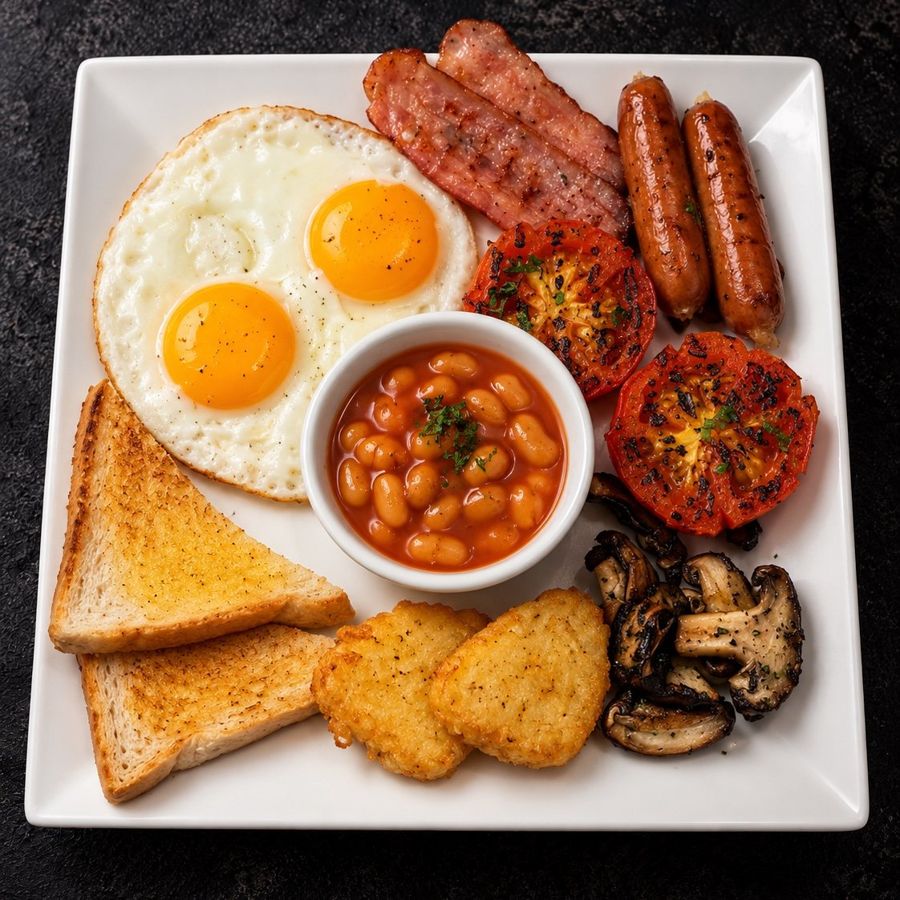
That changes the menu in visible ways. The English breakfast is built with beef bacon and chicken sausages; the sandwiches use halal chicken ham; the Thai side — pad thai, fried rice, tom yum, the pineapple platter — comes out of the same halal kitchen, which is unusual enough on this coast to be worth saying out loud. A family can hand the menu to the children and let them order whatever they want: a small thing that matters a lot on holiday.
Two honest caveats. We do not display a CICOT certificate; we are halal by practice and by supplier, and we will tell you precisely that rather than let you infer more. And there is no beer with your pad thai — for some guests the point, for others a reason to eat elsewhere.
What should you order, and what does it cost?
Prices in baht, including 7% VAT. The full food menu with photos is on the main page.
- English breakfast — 279 ฿. Beef bacon, chicken sausages, eggs, toast — the halal version of the plate most hotels serve with pork.
- Shakshuka — 249 ฿. Eggs baked in tomato and pepper, with bread.
- Omelette — 149 ฿. Add-ons: vegetables +20 ฿, mushrooms +25 ฿, cheese +25 ฿, chicken +30 ฿.
- Avocado toast — 219 ฿ · pancakes — 149–169 ฿.
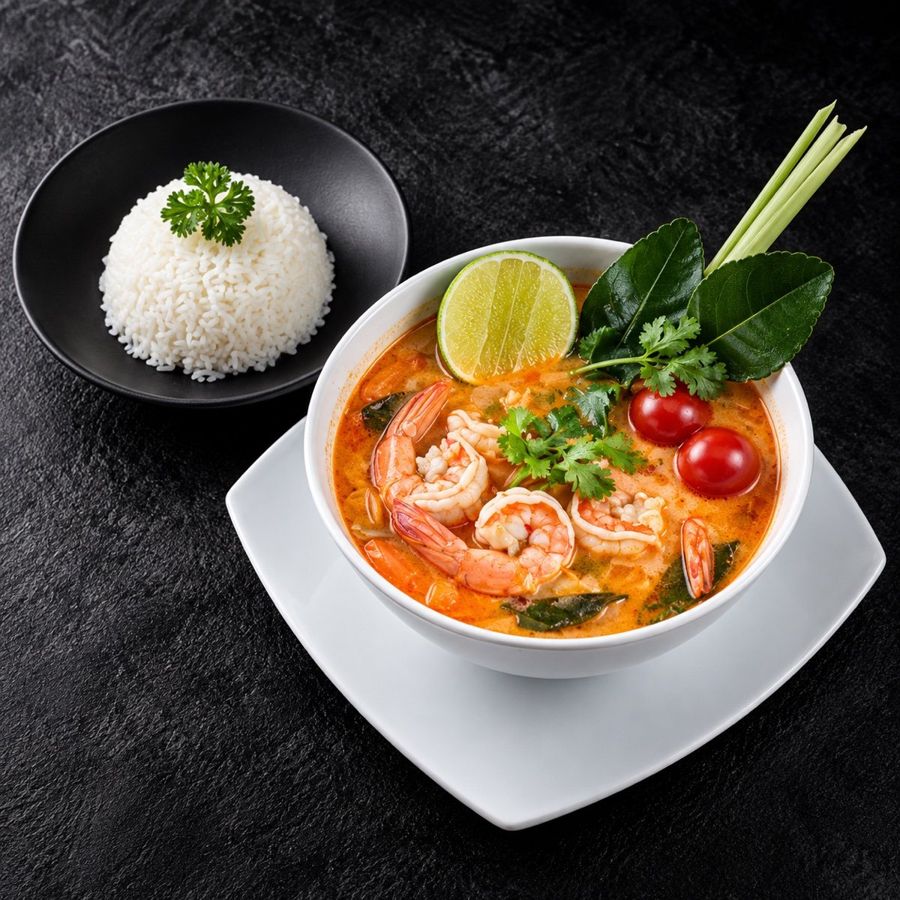
- Pad thai — 219 ฿ · fried rice — 169–199 ฿ · tom yum — 189–239 ฿. Halal Thai food — the sentence this whole guide is about.
- Pineapple fried rice platter — 299–349 ฿. Served in the pineapple, for two to share.
- Sandwiches and wraps — 179–249 ฿ · salads — 149–389 ฿. Halal chicken ham, not pork.
- Coffee from 69 ฿ · matcha latte 99 ฿ · fresh shakes and juices. Oat milk on any milk drink, +35 ฿.
A coffee plus a breakfast plate lands around 250–400 ฿ per person. Cards, PromptPay / Thai QR and cash. Takeaway works if you call ahead; delivery is coming soon.
A short halal checklist for this coast
- Ask about pork, not about “halal”. It gets a clear answer.
- Ask about cooking wine separately from alcohol on the menu.
- No certificate is normal here; no answer is the warning sign.
- Supermarket packets with the CICOT diamond do the checking for you.
- Thursday is our weekly day off.
How to get here
- Address
- 58/2 Srisoonthon Road, Choeng Thale (Cherngtalay), Thalang, Phuket 83110
- Hours
- 10:00 – 19:00 · closed every Thursday
- Phone
- +66 98 067 2795
- Nearby
- 1 km from Surin Beach · 2 km from Bang Tao Beach, Boat Avenue and Laguna Phuket · 3 km from Kamala · 20 km from the airport
- Parking
- Free street parking at the door; scooters at the entrance
- Good to know
- Fully halal, no pork, no alcohol · free Wi-Fi · cards, PromptPay / QR and cash · takeaway available
Coming from Bang Tao, Laguna or Boat Avenue, head south on Srisoonthon Road towards the Surin junction — about five minutes by car, taxi or Grab. From Surin Beach, go inland and we are on your left after roughly a kilometre. From Kamala it is about ten minutes north.
Questions & answers
Is it easy to find halal food near Bang Tao and Surin Beach?
Easier than on most of Phuket. Cherngtalay, the sub-district that covers Surin and Bang Tao, has a long-standing Muslim community, so Muslim-run kitchens, halal butchers and no-alcohol cafés are ordinary here rather than a special search. What you will not find is a halal label on every door, so it is still worth asking one or two direct questions. Nima Cafe at 58/2 Srisoonthon Road is fully halal: no pork, no alcohol, halal meat, open 10:00–19:00 and closed on Thursdays.
How do I know whether a restaurant in Phuket is really halal?
There are two separate signals. The first is the national certificate issued by the Central Islamic Council of Thailand (CICOT), a diamond-shaped logo with the word halal in Arabic; it means an inspected kitchen and is renewed annually. The second, and much more common, is a Muslim-owned kitchen that has never applied for a certificate and runs on reputation instead. Both exist here. If there is no certificate, ask three things: is there pork in the kitchen, is alcohol served or used in cooking, and where does the meat come from. A kitchen that is genuinely halal answers all three without hesitation.
Which common Thai dishes are usually not halal?
Anything with moo (pork) in the name, which covers a lot of noodle soups, grilled skewers and rice plates; dishes cooked in lard or pork stock, including broths that look vegetarian; and anything finished with Chinese cooking wine, which turns up in stir-fries and marinades. Shrimp paste, fish sauce and oyster sauce are made from sea creatures rather than pork, and most Muslims eat them, but some commercial sauces contain alcohol-based flavourings and some travellers avoid shellfish altogether, so it is a fair question to ask. Shared fryers and shared grills are the other thing worth checking in a mixed kitchen.
Is there a mosque near Bang Tao and Surin?
Yes. Masjid Mukarram, the Bang Tao mosque, is the largest in Phuket and sits on the main road through Cherngtalay, a few minutes from both Surin and Bang Tao Beach; it has a separate prayer area for women and its own parking. Several smaller village mosques serve the lanes around Bang Tao and Cherngtalay as well. Inside the resorts and the malls, prayer facilities vary from place to place, so ask at reception or at the information desk rather than assuming.
Is Nima Cafe halal certified?
Our kitchen is fully halal in practice: no pork on the premises at all, no alcohol served or used in cooking, halal meat from our suppliers, beef bacon and chicken sausages instead of pork in the English breakfast, halal chicken ham in the sandwiches, and halal Thai mains including pad thai, fried rice and tom yum. We do not display a CICOT certificate, and we would rather say so plainly than let you assume one. If a certificate is a requirement for you, ask us and we will tell you exactly what we do and do not have.
If you would rather not interrogate a menu on holiday, ours is the short version: all of it is halal.