Thai dishes, the halal way: pad thai, tom yum, fried rice, som tam — what they are and how to order them
Four dishes cover most of what a first-timer wants from a Thai menu: pad thai (sweet-sour noodles, mild), fried rice (the safe one, not spicy), tom yum (hot-and-sour soup, genuinely hot) and som tam (pounded green papaya, the spiciest of the four). The halal questions in Thai cooking are almost always the same three — pork and pork lard, alcohol in some marinades and sauces, and a shared wok or fryer — plus the separate debate about non-fish seafood in oyster sauce. In a fully halal kitchen none of them arise. Ours is one: no pork, no alcohol, pad thai with shrimp 219 ฿, fried rice 169–349 ฿, tom yum 189–239 ฿, som tam 149 ฿.
Why is Thai food tricky if you eat halal?
Not because the dishes are inherently off-limits — most of them are not. It is because of what happens in an ordinary kitchen that has never had to think about it.
- Pork, everywhere. Muu means pork, and it is the default meat in a lot of Thai cooking: minced in noodle bowls, sliced in stir-fries, rendered into lard for frying, simmered into broth. A dish with no visible pork can still have been cooked in it.
- Alcohol in sauces and marinades. Some stir-fry sauces, marinades and batters include rice wine or cooking wine. It is not universal and it is rarely mentioned on a menu.
- One wok, one fryer, one chopping board. This is the part people underestimate. In a busy kitchen the same pan cooks your noodles and the pork dish before it.
- Fish sauce versus oyster sauce. Two different conversations, and worth separating properly — below.
None of this applies in a kitchen that is halal from the start, which is the practical answer: ask whether the kitchen is halal, not whether the dish is.
Fish sauce, oyster sauce — what is actually the issue?
Fish sauce (nam pla) is the salt of Thai cooking: salted, fermented fish, aged into a thin brown liquid, in nearly every savoury dish. It is not alcoholic, and most Muslims regard fish as permissible, so fish sauce is widely accepted as halal. If you prefer to avoid it anyway, the phrase is mai sai nam pla — but expect the dish to taste flatter, because nothing else is doing that job.
Oyster sauce is a genuinely open question rather than a settled one. Schools of Islamic law differ on non-fish sea creatures: some permit everything from the sea, others restrict it to fish proper, which would exclude oysters, shrimp and crab. We are a café, not a source of religious rulings, so we will state it plainly and leave the judgement where it belongs: if you follow a view that excludes shellfish, say so when you order — several of our Thai dishes contain shrimp, and the chicken versions exist precisely for that.
What is pad thai, exactly?
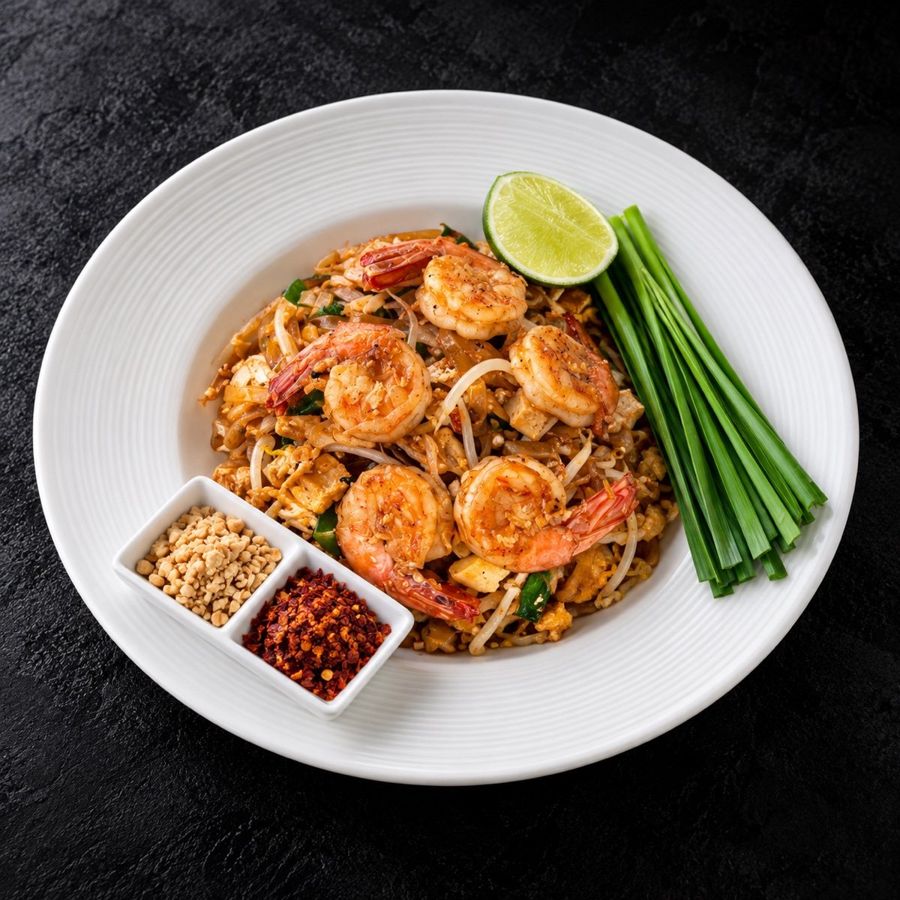
Flat rice noodles stir-fried in a sauce built on three things: tamarind for sourness, palm sugar for sweetness, fish sauce for salt. Into that go egg, bean sprouts and chives, and on the side come crushed peanuts, chilli flakes and a wedge of lime so you can balance the plate yourself.
Heat: mild by design. Pad thai is not a spicy dish — the chilli is a condiment, not an ingredient, which makes it the easiest Thai dish to hand a nervous eater. What to watch for elsewhere: lard for frying, pork cracklings scattered on top, and the shared wok. At Nima: pad thai with shrimp, 219 ฿, peanuts and chilli on the side, lime on the plate.
And tom yum?
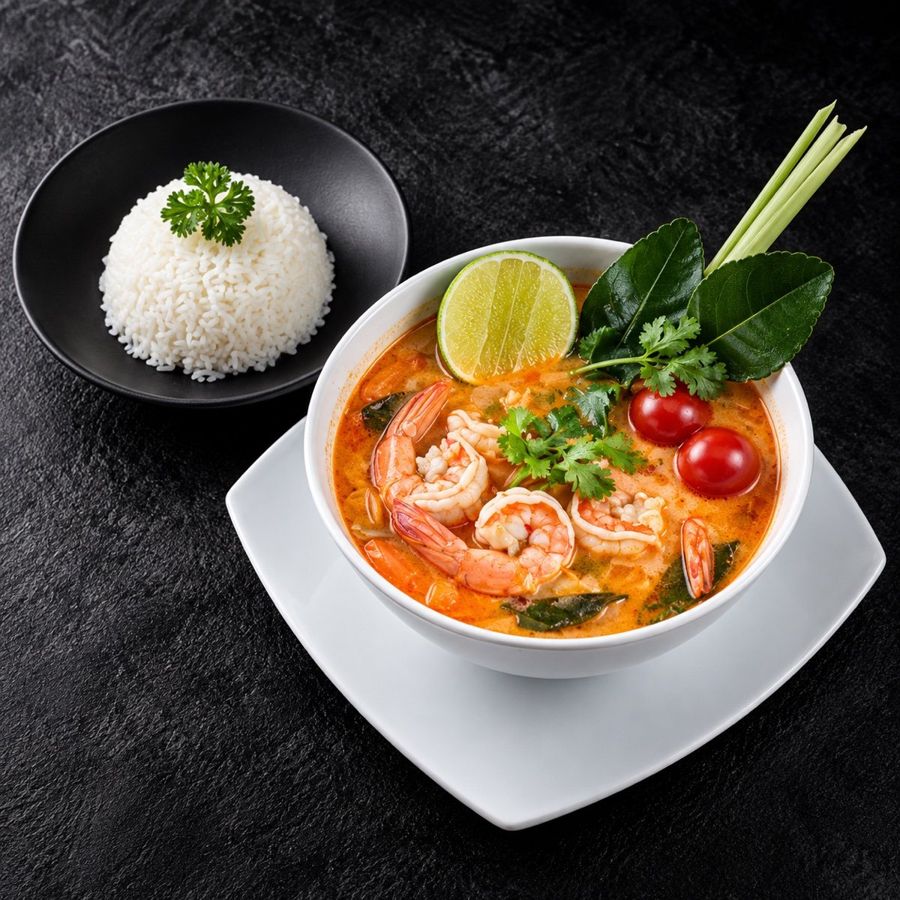
A hot-and-sour soup, and the two words are equally important: heat from chilli, sourness from lime. The broth is built on lemongrass, galangal, kaffir lime leaves and fish sauce, with mushrooms and tomatoes. Goong means shrimp, so tom yum goong is the shrimp version; gai means chicken. You will meet two styles: clear (nam sai) and the creamier one thickened with evaporated milk (nam khon).
Heat: real. This is the dish that surprises people, because the chilli is simmered into the broth and cannot be removed afterwards — if you want it mild, say so when you order. Also worth knowing: the lemongrass stalks, galangal slices and lime leaves are aromatics. Push them to the side of the bowl; nobody chews them. What to watch for elsewhere: pork stock as the base. At Nima: tom yum with jasmine rice, 189 ฿ with chicken or 239 ฿ with shrimp.
Fried rice — the one that never goes wrong
Khao phat is rice wok-fried with egg, vegetables and a protein, usually served with lime and cucumber. It is the least intimidating thing on any Thai menu: never spicy, universally liked by children, and the dish to order when you want to eat without thinking about it. The word to recognise is khao phat muu — that one is pork.
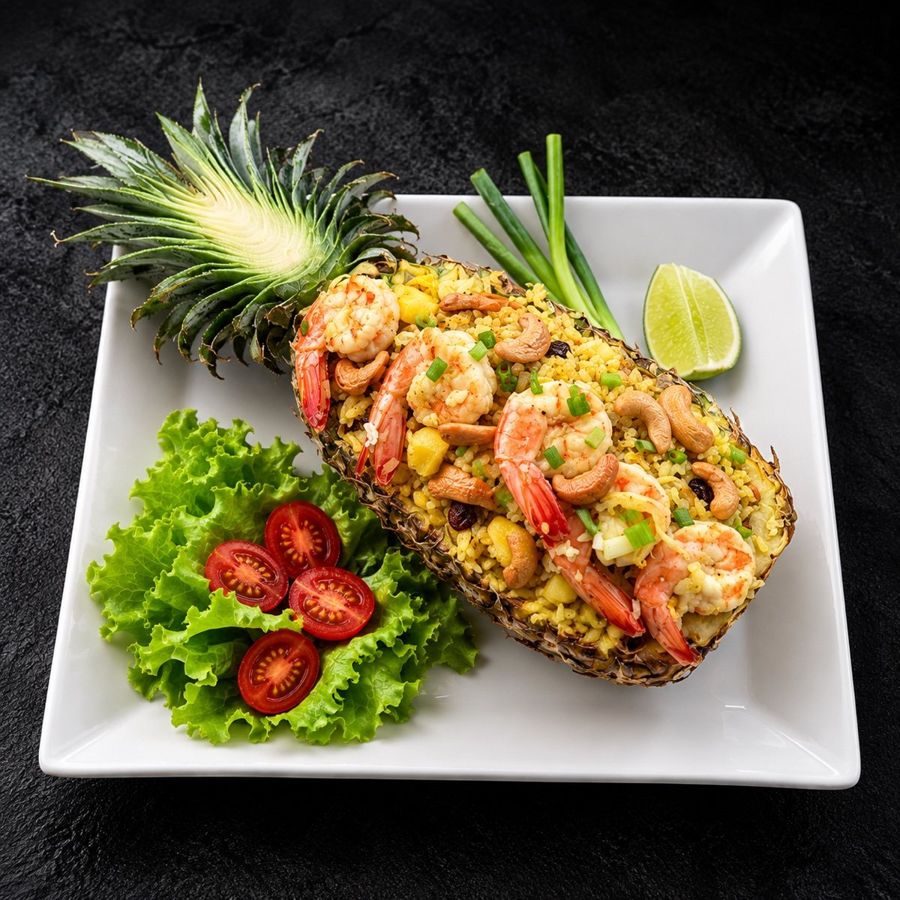
At Nima: chicken fried rice 169 ฿, shrimp fried rice 199 ฿, and the pineapple fried rice platter at 299 ฿ with chicken or 349 ฿ with shrimp — fried rice with pineapple, cashew nuts and raisins, served inside a whole pineapple and portioned for two people. That platter is the easiest thing to put in the middle of a table, and the sweetness makes it the one children finish.
Som tam: how brave are you feeling?
Green, unripe papaya shredded and pounded in a clay mortar with lime, palm sugar, fish sauce, garlic, tomatoes, long beans, peanuts and chilli. Crunchy, sour, salty, sweet and hot all at once, and the most addictive thing on this list once you adjust to it.
Heat: the highest of the four, because the chilli is pounded in at the start. A Thai portion may contain several bird's-eye chillies; two is plenty for most visitors and asking for one is completely normal. What to watch for elsewhere: regional versions made with pla ra (fermented fish paste) or raw salted crab — strong, excellent, and not what you want for a first try or if you are unsure about the kitchen. At Nima: som tam 149 ฿ with shrimp, cherry tomatoes, peanuts, lime and chilli dressing.
How do you ask for what you want, in Thai?
Six phrases cover nearly everything. Say them slowly; staff here are used to them and nobody minds a rough accent.
- mai phet (ไม่เผ็ด) — not spicy. The single most useful thing in this guide.
- phet nit noi (เผ็ดนิดหน่อย) — a little spicy. The middle setting.
- mai sai nam pla (ไม่ใส่น้ำปลา) — no fish sauce.
- mai sai muu (ไม่ใส่หมู) — no pork. Useful anywhere that is not already a halal kitchen.
- mai sai thua (ไม่ใส่ถั่ว) — no peanuts or nuts. Worth memorising if the allergy is serious.
- jay (เจ) — the Thai word for strict vegetarian cooking: no meat, no fish sauce, no egg. Asking for jay food gets you much further than the English word "vegetarian".
And the timing rule that matters more than the vocabulary: ask before it is cooked. Chilli pounded into a som tam or simmered into a tom yum broth is permanent. Chilli served beside a pad thai is optional. Those are different problems.
What should you drink with it?
Water is the thing that does not work — capsaicin does not dissolve in it. Sugar and dairy do help, which is why the traditional pairings are the sweet ones.
- Thai tea — 79 ฿. Strong, sweet, creamy, orange. The classic partner for anything hot, and the single best thing to drink with som tam.
- Es-yen (Thai iced coffee) — 109 ฿. Same idea, with caffeine.
- Fresh juices — 119 ฿. Pineapple with the fried rice, orange with pad thai. No sugar added.
- Fruit shakes — 99 ฿ (mango 119 ฿). Banana or mango blended with ice does the cooling job better than a soda.
- Soda water 30 ฿ · still water 25 ฿. For afterwards.
And the honest note: there is no beer here. We serve no alcohol at all, which for some people is the point and for others is a trade — better to know before you sit down.
What does all this look like on our menu?
Everything in one halal kitchen: no pork, no alcohol, no shared fryer with either. Prices include 7% VAT.
- Pad Thai with Shrimp — 219 ฿. Mild; peanuts and chilli on the side.
- Chicken Fried Rice — 169 ฿ · Shrimp Fried Rice — 199 ฿. Not spicy.
- Pineapple Fried Rice Platter — 299 ฿ chicken / 349 ฿ shrimp. For two; contains cashew nuts.
- Tom Yum Soup with Rice — 189 ฿ chicken / 239 ฿ shrimp. Hot unless you ask otherwise.
- Som Tam — 149 ฿. Spicy by nature; contains shrimp and peanuts.
A first-timer's order, in sequence: chicken fried rice if you are cautious, pad thai if you are curious, tom yum when you have found your level, som tam when you have stopped being careful.
The full list with photographs of every dish is on the food menu, and the rest of the kitchen — breakfast, salads, sandwiches — is explained in our menu guide.
How to get here
- Address
- 58/2 Srisoonthon Road, Choeng Thale (Cherngtalay), Thalang, Phuket 83110
- Hours
- 10:00 – 19:00 · closed every Thursday
- Phone
- +66 98 067 2795
- Nearby
- 1 km from Surin Beach · 2 km from Bang Tao Beach, Boat Avenue and Laguna Phuket · 3 km from Kamala
- Parking
- Free street parking at the door; scooters at the entrance
- Good to know
- Halal kitchen, no pork, no alcohol · Thai mains all day until 19:00 · cards, PromptPay / QR and cash · takeaway (order ahead)
Coming from Bang Tao or Laguna, head south on Srisoonthon Road towards the Surin junction — about five minutes by car, taxi or Grab. From Surin Beach, go inland and we are on your left after roughly a kilometre.
Questions & answers
Is Thai food halal? Is pad thai halal?
The dishes themselves usually can be, but a given kitchen may not be. Pork is ordinary in Thai cooking — as meat, as lard and in stock — some marinades and sauces contain alcohol, and the same wok and fryer are used for everything. None of that is a problem in a halal kitchen. Everything we serve is halal with no pork and no alcohol anywhere, so pad thai with shrimp 219 ฿, fried rice 169–349 ฿, tom yum 189–239 ฿ and som tam 149 ฿ need no questions first.
Does Thai food always contain fish sauce, and is fish sauce halal?
Fish sauce, nam pla, is the salt of Thai cooking and is in most savoury dishes. It is made from salted, fermented fish, and most Muslims treat fish as permissible, so fish sauce is widely accepted as halal — it is not alcoholic. Oyster sauce is a different question, because schools of Islamic law differ on non-fish seafood such as oysters, shrimp and crab. If you follow a view that excludes them, say so when you order rather than assuming, and you can also ask for a dish without fish sauce: mai sai nam pla.
How do I ask for food to be less spicy in Thai?
Say mai phet for not spicy, or phet nit noi for a little spicy. Other useful phrases: mai sai nam pla (no fish sauce), mai sai thua (no peanuts), mai sai muu (no pork). Ask before the dish is cooked, because chilli pounded into a som tam or simmered into a tom yum broth cannot be taken out afterwards. Where chilli is a condiment, as with pad thai, ask for it on the side instead.
Which Thai dish is best if you cannot eat chilli at all?
Fried rice. Chicken fried rice at 169 ฿ and shrimp fried rice at 199 ฿ are not spicy at all, and the pineapple fried rice platter at 299–349 ฿ is sweet rather than hot. Pad thai with shrimp, 219 ฿, is also mild because the peanuts and chilli arrive on the side. Tom yum and som tam are the two to approach carefully — both are meant to be hot, so ask for mild when you order.
Where can I eat halal tom yum and som tam near Bang Tao or Surin?
At Nima, 58/2 Srisoonthon Road in Cherngtalay — about 1 km from Surin Beach and 2 km from Bang Tao, Boat Avenue and Laguna Phuket. Tom yum soup with jasmine rice is 189 ฿ with chicken or 239 ฿ with shrimp, som tam is 149 ฿, and the whole kitchen is halal with no alcohol. Open 10:00–19:00, closed every Thursday. Takeaway available if you call ahead.
Come and find your chilli level. The wok is on from ten until seven, every day but Thursday.